Many packaging lines are optimized for speed, but not for sustainability. Excess material use and energy-heavy processes make it harder for manufacturers to meet environmental goals.
Meanwhile, inconsistent wrapping adds another layer of waste and inefficiency. OCME USA’s end-of-line sustainable packaging equipment addresses these challenges through automation that reduces waste and improves accuracy at every stage of the process.
This article explores how OCME USA’s sustainability solutions help manufacturers lower their environmental impact across every stage of end-of-line packaging, from smarter material use and energy-efficient operation to responsible waste handling.
Packaging Sustainability as an Operational Priority
In industrial manufacturing, the term “sustainable packaging” connotes sustainability in a company’s packaging processes. This means reducing waste and emissions and improving packaging efficiency without compromising product integrity or throughput. Some practices that align with these goals include:
- Minimizing film and board usage
- Reducing power consumption
- Improving transport efficiency
- Supporting recyclable or compostable materials
Given the environmental impact of packaging, retailer programs continue to push suppliers toward lighter, more recyclable packaging. Retailers like Walmart and Amazon publish guidelines and tools that push suppliers toward lighter, recyclable, and right-sized packaging. At the same time, regulators, investors, and customers are pressing manufacturers to demonstrate measurable reductions in environmental impact.
Similarly, many consumer goods companies increasingly utilize sustainability roadmaps that depend on upstream vendors adopting eco-efficient and sustainable packaging equipment.
For packaging teams, this means speed and accuracy are no longer enough, which means sustainable end-of-line packaging solutions are now a requirement rather than an option.
OCME USA helps manufacturers respond to these mounting pressures with sustainable packaging equipment that advances operational sustainability and improves throughput. Our systems are engineered to cut material use and energy demand while addressing downstream inefficiencies, delivering safer, leaner, and more reliable end-of-line performance.
How OCME USA Equipment Contributes to Sustainable Packaging
OCME USA’s sustainability strategy is embedded in the design of our machines and systems. From material optimization to energy reduction and waste management, we innovate technologies that enable manufacturers to meet their sustainability goals.
The company’s solutions can be grouped into six key areas:
- Smarter Use of Packaging Materials
- Eco-Efficient Packaging Systems
- Power-Efficient Components Across OCME Systems
- Sustainable Logistics Through Intelligent Material Handling
- Integrated Monitoring for Continuous Improvement
- Post-Process Waste Management Solutions
1. Smarter Use of Packaging Materials
Reducing material waste is one of the fastest ways to cut costs and lower environmental impact. OCME USA designs packaging equipment to use only the material required while keeping loads secure and transport-efficient. By preventing overpackaging and standardizing application, our systems help manufacturers lower consumption and improve pallet density.
Wrap-Around and Shrink-Wrap Efficiency
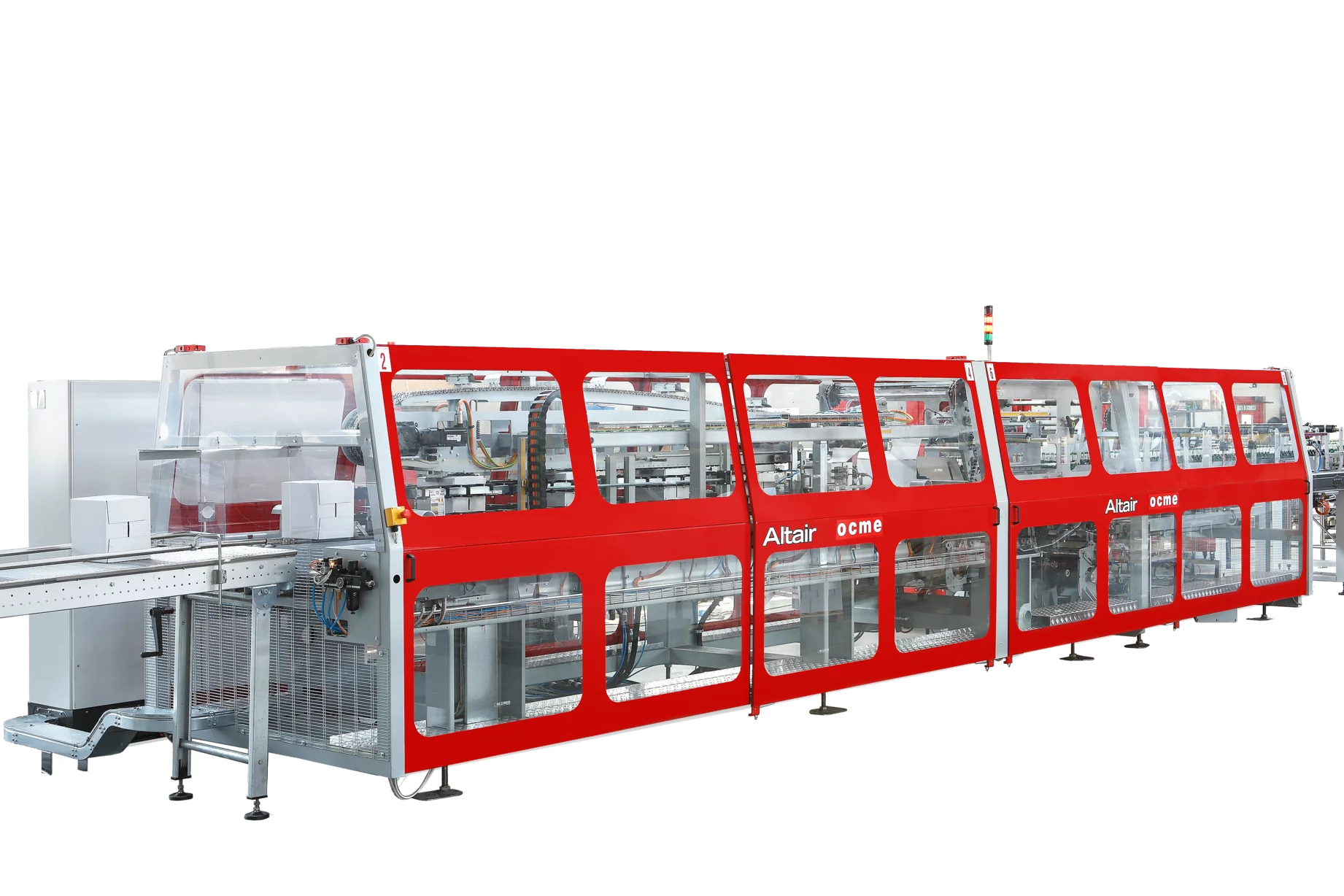
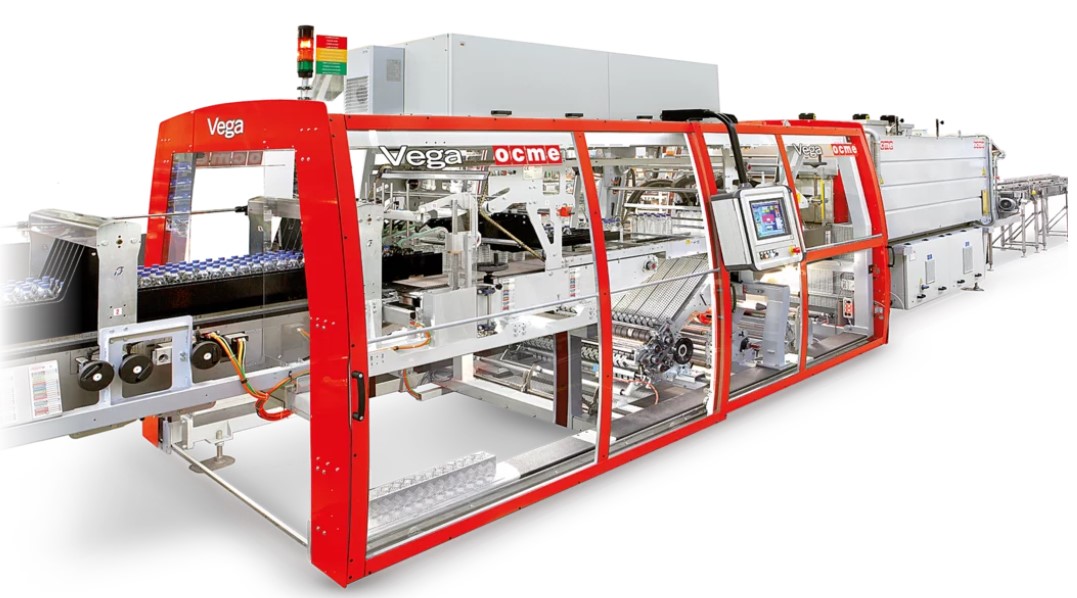
The Altair and Altair HT wrap-around case packers form cartons directly around products to ensure precise secondary packaging. Meanwhile, Vega HT shrink-wrap packers handle film-only, pad+film, tray+film, or tray-only formats and are designed to improve efficiency. Together, these solutions reduce film waste and eliminate the need for oversized cases, inserts, or filler.
Key features that support material savings include:
- Servo-controlled carton blank folding for dimensional precision
- Adjustable format capabilities to accommodate different product sizes without overpackaging
- Seamless integration with upstream and downstream conveyors to maintain line balance
Technoplat PW: a Paper-Based Alternative
Robopac’s Technoplat PW replaces plastic film with recyclable paper for pallet wrapping. Presented at HISPACK 2024, it gives manufacturers a practical route to reduce plastic consumption without sacrificing load stability.
Partnerships for Recycled Shrink Film
OCME also works with partners to advance material innovation. With ExxonMobil Chemical and RKW Group, we developed a collation shrink film containing 50% post-consumer recycled content. Based on ExxonMobil’s Enable™ 4002 polymer, the film maintains the strength and optics of virgin polyethylene. RKW converts this into printed reels for use on both OCME and Robopac machines, enabling manufacturers to adopt recycled shrink film at scale.
This solution can be used on both OCME and Robopac machines, marking a step forward in the adoption of recycled shrink film packaging.
2. Eco-Efficient Packaging Systems
OCME USA’s approach to eco-efficiency begins with system-level engineering. When case packers, shrink wrappers, and palletizers are designed to work together, plants gain three measurable advantages:
- Reduced idle time, as machines no longer wait for upstream or downstream processes
- Streamlined material flow, which cuts energy lost to inefficiencies and stops
- Lower redundant energy use, because machines avoid repeating unnecessary cycles
For instance, when an Altair wrap-around case packer is paired with a Prasmatic TC series shrink wrapper and an OCME Pegasus robotic palletizer, the line balances product flow automatically. This combination may help reduce bottlenecks and prevent idle operation, supporting greater efficiency and reduced energy consumption.
Increased automation also helps avoid overpackaging by standardizing dimensions more precisely than manual handling. This not only reduces material use but also improves pallet stability and shipping efficiency.
Other benefits of integrated energy-efficient packaging systems include:
- Reduced manual intervention
- More consistent product handling
- Fewer secondary packaging adjustments
Together, these systems contribute to lower overall environmental impact per packaged unit without slowing throughput.
3. Power-Efficient Components Across OCME Systems
Energy efficiency results from the advanced components that drive OCME equipment. Across our machine lines, we integrate features like:
- Servo and Drive Systems: These are designed to adapt power to real-time load requirements so machines draw only what they need.
- Low-energy Shrink Tunnels: They maintain consistent film sealing while operating with reduced thermal output, helping cut unnecessary demand.
- The Vega HT: This line can be equipped with an energy-saving kit that lowers power consumption during packaging cycles.
- Intelligent Software Controls: These automatically place machines into low-power standby modes during downtime, reducing waste.
In the Vega HT case packer, motion is driven by brushless motors that provide energy-efficient acceleration and deceleration for each operation. OCME also provides monitoring systems that help facilities track KPIs such as energy per case, supporting their sustainability audits.
OCME’s palletizers, such as the Perseus and Pegasus series, feature advanced load optimization controls that minimize unnecessary movements while maximizing stability. This reduces energy demand and stretch film consumption during wrapping.
Benefits for manufacturers include:
- Reduced peak energy demand
- Lower electricity costs per shift
- Improved equipment longevity through smart controls
- More predictable operational costs in energy-intensive environments
4. Sustainable Logistics Through Intelligent Material Handling
Manual forklift traffic contributes to fuel consumption and emissions, as well as increases workplace risk. OCME’s Auriga LGV line addresses these issues by automating material transport between packaging stations.
Auriga laser-guided vehicles (LGVs):
- Operate on electric power with low energy demand
- Follow optimized routes to reduce total movement
- Require no human operation or onboard fuel
- Integrate with warehouse management systems for predictive routing
Auriga LGVs are designed to replace manual forklifts, which helps facilities lower fuel use and reduce pallet damage, while creating safer traffic patterns on the production floor.
The Auriga SFT model is optimized for medium- to high-speed routes and can be integrated into lines that include multiple case packers, palletizers, and wrapping stations. Meanwhile, the Auriga PS variant specializes in heavy-load handling, enabling safe and efficient movement of bulk pallets without conventional forklifts.
At HISPACK 2024, OCME demonstrated the integration of Auriga LGVs with other sustainability-focused technologies, including the Technoplat PW and ReCYCLE. Our display of these innovations highlights our commitment to reducing environmental impact across the entire packaging line, from pallet wrapping to internal logistics and waste management.
5. Integrated Monitoring for Continuous Improvement
OCME USA provides digital integration that helps facilities track and improve sustainability performance over time. The capabilities of our solutions include:
- Real-time monitoring of film, board, and energy use
- Preventive maintenance alerts to reduce waste from breakdowns
- Production reporting to identify inefficiencies or material losses
Many OCME USA systems, particularly in the Auriga LGV range, include data-supervision capabilities. For example, Auriga vehicles are monitored and managed through interfaces that archive operational parameters and the current status of charge and load.
OCME USA also provides tools that support “energy per case” reporting and plant-level dashboards. While not all models have identical feature sets, this insight helps identify inefficiencies, optimize maintenance scheduling, and compare performance across lines.
Without visibility, companies risk overconsuming materials or missing opportunities to reduce energy. Integrated monitoring helps sustainability managers prove results during audits and demonstrate compliance with internal KPIs or external mandates.
6. Post-Process Waste Management Solutions
After packaging is complete, managing waste remains a challenge. The ReCYCLE system addresses this by compacting packaging scrap at the point of generation.
Its capabilities include:
- Reducing waste volume by up to 70%
- Cutting down on hauling costs and bin space
- Improving safety and cleanliness in packaging zones
ReCYCLE integrates into packaging areas where scrap film, corrugated board, and other disposables accumulate. The system supports closed-loop thinking, optimizing how materials are used and how they’re disposed of responsibly.
By reducing the footprint of discarded materials, ReCYCLE enables cleaner, leaner operations and contributes directly to corporate waste reduction targets.
Packaging Equipment That Supports Sustainability and Performance
OCME USA’s equipment portfolio shows that sustainable packaging operations can still be fast, consistent, and cost-effective. Machines like the Altair wrap-around case packer, Technoplat PW turntable, and Auriga LGVs deliver:
- Lower energy and material use per packaged unit
- High-speed automation with fewer operator interventions
- Better packaging integrity across varying load types
These systems allow manufacturers to:
- Maintain packaging quality while reducing film and board use
- Lower carbon footprint per shift or unit produced
- Operate more predictably and efficiently over time
- Use recycled shrink film packaging and other sustainable materials (for packers)
OCME USA combines decades of experience in packaging automation with continuous innovation, ensuring our solutions align with current operational needs and future sustainability mandates.
As a global leader in end-of-line automation, we help manufacturers move toward greener operations without compromising performance. Connect with OCME USA today to explore customized packaging solutions that support your organization’s environmental goals.

